
Pond Literage Calculator
Measure your pond and the calculator gives its volume in litres and gallons, the pump flow you need for your fish, and the size of liner to buy. It handles rectangular, circular, oval and irregular ponds with sloped sides.
- Free to use
- No sign-up
- Runs in your browser
Calculate pond volume
Pond Keeper's Workbook
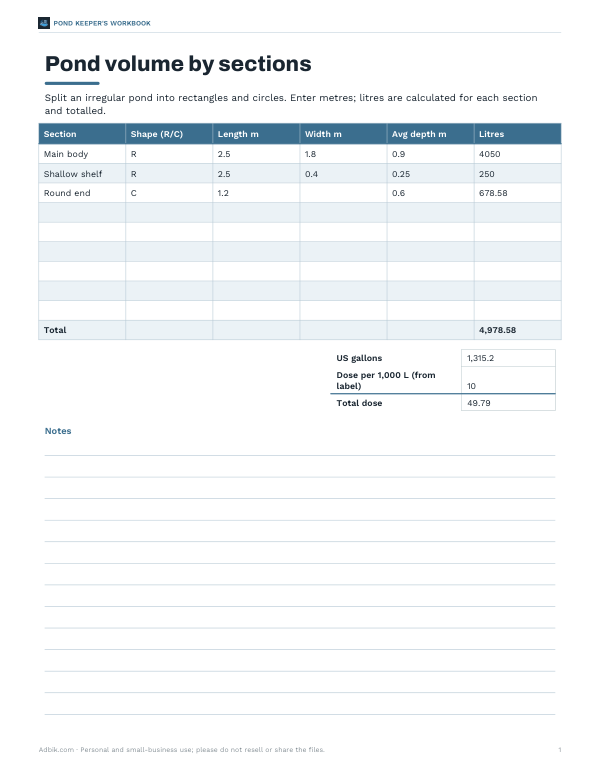
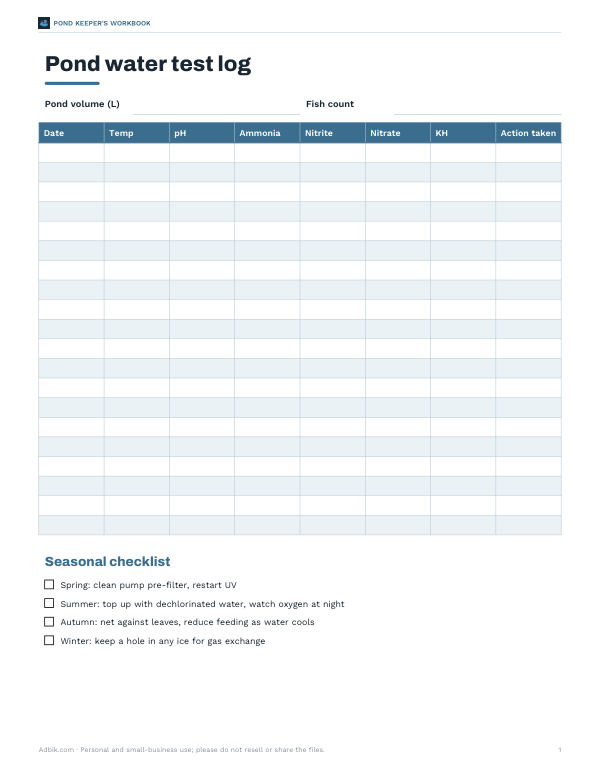
Volume by sections for irregular ponds, pump head-loss planning, a water-test log and a dosing sheet.
- Volume-by-sections & dosing workbook (XLSX, PDF)
- Water test & maintenance log (PDF, DOCX)
Formats: XLSX, PDF, DOCX. Instant download after payment (link valid 72 hours, up to 5 downloads). AI-assisted: the templates were drafted with AI help and reviewed and laid out before publishing.
$4.00 USD, one-time
- Instant download
- 7-day refund
- Secure checkout by Stripe
7-day money-back guarantee. Full refund within 7 days of purchase, even after you download.
Full refund within 7 days — see the refund policy and license.
Free printables
Single sheets you can print right now, no sign-up. The full pack adds every sheet in one download plus the editable files.
Why pond volume matters
Knowing how many litres your pond holds is the starting point for almost every pond decision: the size of pump and filter, the dose of any water treatment or medication, how many fish the pond can support, and how much salt to add when treating koi. Guessing is risky — an overestimate leads to overdosing treatments, an underestimate to an overloaded filter and poor water quality.
Formulas used
- Rectangle: length × width × average depth.
- Circle: π × (diameter ÷ 2)² × average depth.
- Oval: π × (length ÷ 2) × (width ÷ 2) × average depth.
- Cubic metres × 1,000 = litres.
- Litres ÷ 3.785 = US gallons; litres ÷ 4.546 = UK (imperial) gallons.
- Cubic feet × 28.32 = litres, or × 7.48 = US gallons.
Always use the average depth, not the deepest point. Most ponds have shelves and sloping sides, so the average is typically well below the maximum depth. Measure the depth at several points across the pond and average them.
Measuring an irregular pond
Kidney-shaped and naturalistic ponds are the norm, so the calculator's irregular option multiplies the longest length by the average width and takes 85% of that rectangle as a first estimate. For a better figure, divide the pond into simple shapes — a rectangle for the main body, a half-circle at one end — calculate each, and add them together. Another accurate method is to read your water meter before and after filling or topping up, if the pond was filled from the mains.
Choosing a pump
Pond keepers usually size pumps by how often the whole volume should pass through the filter. The calculator uses common rules of thumb:
| Pond type | Turnover | Pump flow for a 5,000-litre pond |
|---|---|---|
| Koi pond | Whole volume every hour | 5,000 L/h |
| Goldfish or mixed fish | Every 2 hours | 2,500 L/h |
| Wildlife pond, no fish | Every 2–3 hours, or less | 1,700–2,500 L/h |
| Waterfall or stream | Add flow for the feature | Check the pump's head-height chart |
Pump ratings are given at zero height. Every metre the water is lifted — to a filter, waterfall or fountain — and every length of pipe reduces the actual flow, so choose a pump whose flow at your required head height meets the target. Filters also have a maximum pond size and flow rating; stay within the manufacturer's figures for the fish you keep.
Liner size
For a flexible liner, add twice the maximum depth to both the length and the width, plus an overlap around the edge so the liner can be anchored under paving or soil. This calculator adds 30 cm (about 1 foot) of overlap on each side. The formula is: liner length = pond length + 2 × max depth + 2 × overlap; liner width = pond width + 2 × max depth + 2 × overlap. Measure at the widest and longest points, and round up to the next size your supplier sells.
Worked example
A rectangular pond 3 m long and 2 m wide with an average depth of 0.8 m holds 3 × 2 × 0.8 = 4.8 m³, or 4,800 litres (about 1,268 US gallons). For goldfish, a pump moving 2,400 litres per hour at the height of your filter is a good target; for koi, 4,800 litres per hour. With a maximum depth of 1 m, the liner should be about 5.6 × 4.6 m.
Evaporation, top-ups and rainfall
Ponds lose water to evaporation every day in warm weather — often a centimetre or more in a hot, windy spell, and more if you run a waterfall or fountain that sprays water into the air. Knowing the surface area from the calculator lets you turn that into litres: a 6 m² pond losing 1 cm a day loses about 60 litres. Top up little and often with dechlorinated water rather than refilling a large fraction at once, which can shock fish with a sudden change in temperature or water chemistry. Heavy rain can raise the level and dilute treatments, so an overflow pipe that keeps the level steady is worth building into a new pond.
How many fish can the pond hold?
Stocking limits depend on filtration, but a conservative guide for goldfish is about 2.5 cm (1 inch) of fish length per 100 litres of water, counted at adult size. Koi grow much larger and need deep, well-filtered ponds; many koi keepers recommend at least around 1,000 US gallons for a small group and plenty more for each additional fish. Fish grow and breed, so stock below the limit and let the filter mature before adding more.
Water treatment doses
Dechlorinators, bacteria starters, salt and medications are dosed per litre or gallon, so keep a note of your pond's volume near your supplies. When in doubt, dose for the lower volume estimate and increase if needed, rather than overdosing. Remember that UK products may use imperial gallons, while US products use US gallons — the difference is about 20%.
Frequently asked questions
How many litres in a cubic metre?
Exactly 1,000 litres.
How do I convert cubic feet to gallons?
Multiply cubic feet by 7.48 for US gallons, or by 6.23 for UK gallons.
Should I measure maximum or average depth?
Average depth for volume; maximum depth for liner size.
What size pump do I need for koi?
Aim to move the whole pond volume through the filter about once an hour, at your actual pumping height.
Why does my volume differ from my water meter?
Shelves, slopes, rocks and plant baskets displace water. The meter reading of a full fill is usually the more accurate figure.